Author Archives: scooter

Sarah Rae

Been meaning to try out a Joel Grimes style high-key blown-out image for a while.  I got a message from a local shooter – John Gannon, who’d recently built a studio – in his back garden, was busy teaching himself to shoot pictures and had a fantastic model – Sarah Rae from Bournemouth, at his studio all day.  It just said – you’re local – fancy shooting with Sarah in my studio – just pay Sarah for her time.  Well

66922_10201731133459721_1898826098_n

– how could I refuse?  It would seem rude! John’s back yard studio is a good size and he’s equipped it with basic lighting, a lot of backdrops, and even a little make-up station.  Sarah showed up right on time with a massive wardrobe packed into 3 cases.  She had been on tour in the North West for 3 weeks or so.  I only intended to spend a couple of hours there, however Sarah has such a fantastical look – intense impressions, with an overwhelming sense of concentrated attention – and John’s a brilliant bloke – very generous, helpful and dead easy to get on with.  I ended up spending 4 hours shooting with Sarah, and we got some great results.

So, first up was the Joel Grimes nuclear detonation light-everywhere shot.  Joel uses some really big modifiers to provide fill left and right and a medium/large softbox to provide slightly more directional light from the front and centre.  Go watch his videos on “Lit Up” – they’re really useful. I didn’t have 2 really big modifiers, however, the walls of John’s studio are all white, so I pointed both of his small softboxes at the left and right walls/pitched roof which had the perfect angle to reflect that light as a massive soft light source back onto Sarah. Continue reading
Back to the insect studio

Shot a lot of studio based images over the last year or more.  That is, with controlled light, and human models.  A while ago, I shot some images of flies in a studio set, with basic, “light all around” lighting, even underneath, courtesy of my Lee lens cap/diffuser stand for the insects.   I was wondering how many other light set-ups would translate to the “small stage” and decided to try a classic 3 light set-up:  2 edge lights either side, plus one main light feathered away to give some nice shadows across the face.. er I mean outer wings..

IMG_2031

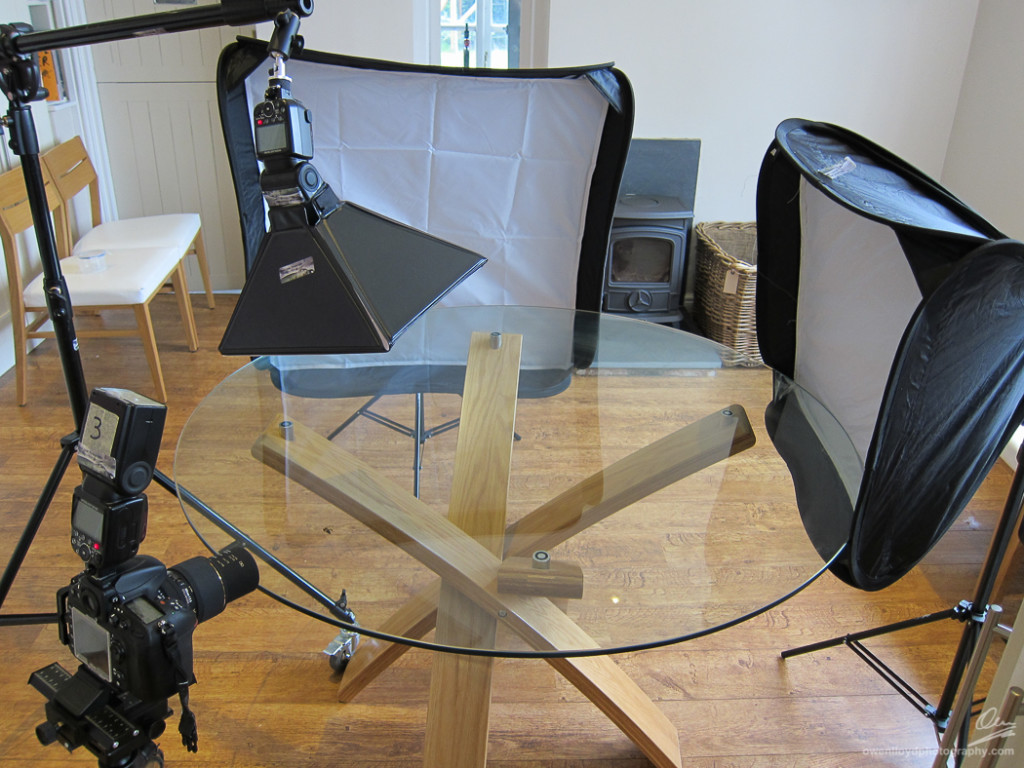
I had seen a similar set-up to the one below used to photograph insects.  The general idea is to create a black strip down the glass between the soft boxes at the back, that will back-light the subject.  Shoot really low and front-light the subject with a another soft-box overhead.  The base (table in my case) should come out black as light not hitting the subject should pass through the glass.

The set-up you can see to the left was made using these items:-

  • 2 x MKStudio soft-boxes for Speedlights on 2 lightweight stands
  • A Lumiquest LTP soft-box for the main light
  • 3 x SB-900 Speedlights
  • Another SB-900 used as the commander.
  • Sigma 105mm macro lens
  • D800E
  • Heavy duty boom stand
  • Glass table
  • The HTPhoto dual axis macro rail and tripod was quickly abandoned when it became apparent I would have to chase the live subject about …. Continue reading

Lighting the Amtech yoghurt pot machine

One of the things I like about photography is the engineering challenges it presents – that is, how do you overcome the various barriers between the shot you have in your head, and what you can arrange to appear inside the memory card.  These maybe how you get access to the viewpoint, how you get all of the bits you need in focus, capture the moment or get the required light to the subject.

So, when Sue Clifford, a fellow member of Holmes Chapel Camera Club and commercial portrait photographer, said she had a commission to photograph a monster piece of machinery, and could I help out, well, I just had to see it.

Here’s a 180 degree panorama shot on my iPhone:-

amtech-pano

Continue reading

Miss Fahrenheit

_OHL6251-Edit

A trial of running a studio background in our kitchen.  Not ideal, however it worked just fine for head-shots, 3 quarter and we even squeezed in a few full length ideas.  I can see a few ways of getting some more room to the sides for the lights for future shoots.  First time I’ve ever put out a casting call for “TF” i.e. Time for Images, or doublespeak for a collaboration shoot between model and photographer.  I advertised for a model for this shoot on Purple-Port – a marvellous photographer/make up artist/model/studio networking and marketing site.  Miss Fahrenheit applied.    This all worked very well.  I hear stories all the time about how either the model or the photographer didn’t show up and I guess you will get those, however I got a good feeling from the emails that Miss F. was serious, and besides, I was doing this at home, so the risk was minimal as I hadn’t paid out for studio time. Continue reading

Sunstars

Sunstars are the star shaped rays of light you get from a point source, when shooting a wide-angle lens stopped down.  I recently did a short test on most of my wide angle lenses to see which gave the best sunstars.  I included the 70-300mm as well just to see.  I used a small LED torch as the light source about 2 metres away, focused on it, and took shots at f/8,  f/11 and f/16 with each lens, except the Zeiss 50mm which ash f/8, f/16 and f/22.  The number and shape of the blades that make up the diaphragm should determine how many points the star has, with straight bladed diaphragms giving the most defined stars.


Continue reading

Jurassic Coast


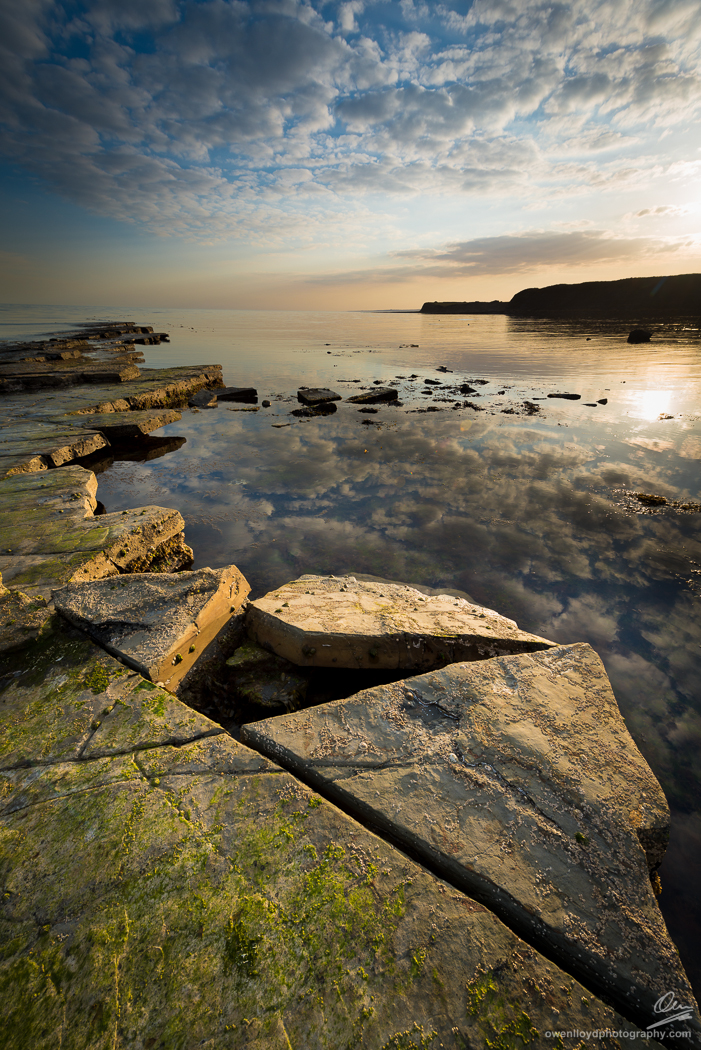
I was due in Poole on Wednesday morning so decided to drive down the day before and visit the coast for some landscapary before checking into the hotel.  It’s a 4.5 hour drive from my house and I plumbed the Durdle Door car park into the sat-nav.  Was all going well until I got within about 5 miles, at which point, the radio announced that the path down to the beach in Lulcroft bay had, well, fallen off.  That’s right, just as I get within a few miles of the place, the cliff fell apart, taking the steps down to the beach with it.  Oh well.

I changed course and, navigating by the sun, I headed south until I ran out of land and parked.  I had arrived in Kimmeridge bay, a few miles to the east of Durdle door.  It was about 4 hours to sunset so plenty of time to go down the path to the “beach” and look for some shots.  The beach is covered in large smooth, round boulders.  The cliffs have very obvious strata, which continue under the boulders on the beach, and as they are not quite horizontal, huge flat plates of harder rock jut out of the ground at a shallow angle.  This has created some spectacular rocky ridges out into the bay, and it looked like I was on for some sidelight from the sun in a couple of hours time.

The tides are a little weird in this area, with a double dip before it comes in properly, but from the looks of the graph on the tides planner, it looked like the rocky outcroppings would still be visible when the light arrived.  If they were covered, I figured the water would be up to the nice round boulders and I’d do those instead.  Went back up to the car park and brought the gear down, scoped out 3 compositions, put the main bag down out of the way of all 3 shots and set up on the first one, got the composition in, focus set and filter holder attached to the 14-24mm Nikkor.

Made the shots mainly using a 3 stop hard grad to control the sun and it’s reflection, and bracketed 5 stops (2 up and 2 down).   Adjusted the shot to include more sky when these wonderful clouds arrived.

Now, I checked the ISO, WB, exposure comp, and formatted the card, however what thunder-thumbs forgot was that the 14-24mm has round blades on it’s diaphragm and so renders the sun as a general mush.  Rounded aperture blades make nicer out of focus areas as the specular highlights are more circular.  However you don’t tend to shoot selective focus so close in like this and you don’t get nice sun-stars when the lens is stopped down.  I should have used the old 20mm AIS that has 7 straight blades.  Next time..  I did try cropping the sun out but I do prefer this one.  I might use the tighter crop for competitions as judges always pick up on highlights near the edge of the frame.


Why you’d be daft to shoot jpeg only.

What is the difference between raw and jpeg shooting?

Photography print magazines especially like to create whole articles on this subject – like there is a choice.  There really isn’t – unless you’re a press shooter, you’d have to be mad to shoot jpeg if you care about your images.  They like to go on and “compare” jpeg and raw images, as if you can actually view a raw file.  If you open a raw file, it is converted there and then to fit into the colour space and range of tones that your display device can support.  In effect then you are just comparing jpeg to another jpeg – just developed using a different set of values.

OK, before we get into this, lets be clear that file formats are not the issue here – yes jpeg is compressed: well guess what?  Nikon cameras can do compressed raw files too (lossless and lossy) and I’ll be surprised if others don’t also.  Compression is another debate, and does not really affect the image quality at all.  However, as a side effect of making a jpeg, the camera *must* process the image – with no input from you; and that’s what is really at stake here – do you want default processing, or would you like some input to the process?

Continue reading

Remo Rebelle


Now, about these modelling names.  Normally I can’t be doing with all of that.  Talking to someone and calling them “Sparkle” or “Shiny Stone” or something is just odd.  However, Remo has a real job and a life she’d rather keep separate from her modelling work and that’s fine with me.

Remo contacted me with a brief for 3 styles of shot, with lots of pictures and descriptions of clothing, styles and examples.  I liked Remo’s ideas a lot so a few weeks later we met at Pathways Studio in Chester to make them.  Also on-set we had a fantastic make-up artist, Victoria and my assistant for the day – my friend Sandy Auden.  It always helps if your assistant is a photographer, and Sandy is an accomplished concert and event shooter – more used to extracting good images in sh*tty light…  The idea you could actually turn it up and down intrigued her and she agreed to come help out – and did a brilliant job.

The first set was inspired by the sort of 1950’s Hollywood, film-noir style light with the subject the classic “femme-fatale” that often featured in these movies. As Remo’s outfit was all black, we needed some fill which is provided by the gridded strip-box on the right.  This is feathered off towards camera.  The main light, a gridded beauty dish, is actually hidden behind that strip-box and is aimed at her head and shoulders.  The last light, the edge light is off to camera left lighting the hair and providing edge light down her right arm.

Continue reading