Author Archives: scooter

Day Out at Media City

TeamHad a fabulous time down at the BBC. Media City, in Salford last Thursday at the finals of the Barclays/BBC University Technology Challenge.  My team from Edge Hill University put on a fantastic presentation of their solution, full cost model, business case and project plan which was the product of many, many hours of hard work.  Sadly they didn’t win, however I’m extremely proud to have worked with them and I know they’ll go on to even bigger and better things.   Our hosts down at Media City were brilliant, and as it was well after breakfast, let us use this sofa for the team shot :)

The buildings and approach to their work at the BBC is an eye opener – I always assumed they had big dedicated studios for everything with big red lights on the doors.  What I saw though was lots of content being created with the minimum of kit, set and fuss, more or less in the office – in clearings inside the desk forest.  There are no “offices” as such, everyone sits out at a regular desk, and programmes are being made all over the place.  The furniture is lovely, creating little rooms within each floor.  Now, they do have some “proper” studios over in the building helpfully labelled “Studios” and there are a couple of more dedicated spaces for the sports reporting.    Couldn’t resist a quick shot in there so here’s one of my friend Julie in the chair.  I used the Nikon 28-300mm again for all of these shots.

Even the views out of the window are spectacular given the right sunset  !  Thanks to Christine Bellamy and the team at the BBC for being such fantastic hosts.

Continue reading

Have lens, will travel…

_OHL1478

Travel photography means variety.  You shoot what you see.  Well, the things you see that you like the look of anyway.  To cater for this, I’ve always carried a bag full of lenses – mid range zoom (24-70mm), telephoto zoom (70-300mm), wide angle (14-24mm) and some low light, low DOF lenses (50mm, 85mm f/1.8).  I’ve even carried a 105mm macro as well.

Continue reading

Nikon loses plot–starts selling ”lifestyle” cameras

Oooohkaaayyy so Nikon has finally released their new “Df” camera.  Whilst other manufacturers like Sony are advancing the art of the digital camera by removing legacy “features” left over from the days of film (flappy mirrors and shutters), Nikon has put a random collection of DSLR parts into an F3 film camera body and is asking Two Thousand, Seven Hundred and Forty Nine actual real pounds for it.

Continue reading

More flash hacking…

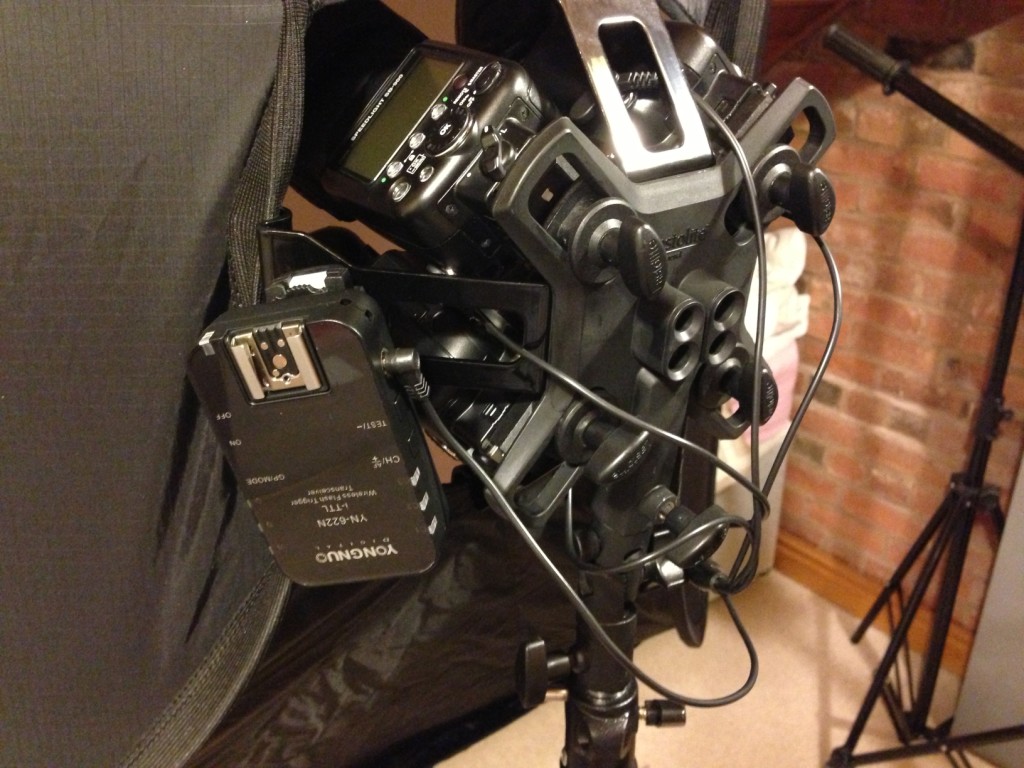
Arduino flash trigger prototype 1

Up until a few years ago, bolting bits of electronics together to do complex things was quite a steep learning curve.   If you could do it all without any processing, you could connect individual logic gates together to make things happen.  There is a lot to wrap your brain around to get things to work.  Happily, now there are a number of small computers around that are focussed on input and output at a basic level – reading voltages, or on/off states and outputting them on other connections too.

I built an Arduino based robot kit from 4Tronix recently.  It comes with 3 sensors:  an ultrasonic range-finder, active infra-red obstacle detectors and a air of line followers  (detects light or dark surface).   The logic is in software – you write code saying things like “if this sensor says ‘Yes there’s summit there’  then send a signal out of this connector”.  It’s really easy to learn (especially if you wrote code in C 20 years ago, the constructs for loops and blocks are identical, however all the complex bits are gone – we built 25 of these robots and got 13-14 year old school kids to program them.  They all picked it up in about 10 minutes).   In this way you could make the robot move in a certain way depending on what the sensors saw.   This got me thinking:  I know how the object sensors work, and I know now, having messed with Triggertrap mobile app, how to trigger my flash.  Can I put the 2 together? Continue reading

The Speed of Light

photo 2

Or, more importantly, the duration of the light really.  I’m gearing up to do some motion freezing shots using flash.  Now, why do this with flash?  We could just use a really high shutter speed and yes, the shutter on my Nikon D800E will go to 1/8000th of a second, which is fast enough to freeze most action in the “medium sized world”.  However, there are a couple of reasons why this is not a good idea.

First, for shots where we need to the camera to react to a noise, vibration or something breaking a detector beam, there may not be time for all of the mechanical gubbins inside the camera to lumber into action before the event is over:  the mirror has to raise, the whole shutter has to start it’s operation etc.  All of this can add as much as 50ms between the trigger event, and the exposure starting.  The second reason has to do with the amount of light we have to work with:  at 1/8000th of  second, not a lot of light is going to get in.

Now, one of the best things about speedlights is that you can’t alter the power.  Yep read that again 🙂  Speedlights do not work in the same way as conventional studio lights.  Whereas studio lights charge up their capacitors with just the right amount of energy for the light output you want, speedlights are always fully charged.  You control the amount of light by altering the duration of the light.  They have a tap inside – these days this is normally an Insulated Gate Bipolar Transistor or IGBT.  So rather than a trigger voltage discharging the whole cap across the flash-tube, your speedlight can turn the flow of electrical energy to the tube on and off.  The power of your speedlight btw, may amaze you.  Power is the rate or flow of energy (the rate of “doing work” in generic terms).  It is not the amount of energy delivered.  Your average speedlight holds around 80 joules of energy in its capacitors.  To empty them fully takes about 1/900th of a second.  1 watt is 1 joule per second, so dividing 80 by 1/900th gives us 72 kilowatts.  That’s a pretty bright light – for just over a millisecond…. Continue reading

Shooting models

_OHL0441-EditNo – not people from agencies – little models of cars.   Automotive shooters reckon you need a soft-box at least twice as big as the car to get great clean looking light on a car, which is basically a big convex shiny thing that reflects everything for miles around.  Who has a 20 ft soft-box?  hands-up?  Nobody?  Anyone get a car sized studio space with a diffusion panel under the roof?  No? Continue reading

Classic beauty/cosmetics shot how-to

_OHL9996-WebI always like to get a shot of every model using this set-up.  Once you set it up, it’s so bullet proof, even I can do it without too much head scratching.  Often called “clamshell lighting” as the lights resemble an open clam from the side, there are many variations on this lighting set-up, however they all have one light centred over the top of the model but angled more towards the horizontal, with another light or reflector below.  You can then light the background from the front or the back.

Lastolite Triflector II

Nah….

You can actually buy a thing called a “triflector” from Lastolite that has 3 panels that reflect from the bottom, left and right for a wraparound fill.  I don’t use side reflectors – I find it makes the face look fat.  In fact, I don’t use a reflector at all – I prefer to use a powered fill light, as I can then position it lower out of the way, and can have as much power in it as I like.  I almost always use a small beauty dish directly overhead and centred, sometimes with the diffuser on, sometimes not – depends on how good the subject’s skin is:  putting the diffuser on will smooth it out a bit by reducing the micro-shadows around any skin defects.  For fill, I will use a softbox on a floor stand angled up just off horizontal – maybe 30 degrees.  This is powered up to 1 stop below the main light.


Continue reading

Lighting-stock 4 – the HCCC studio-fest

Martin Pawlett and I have been organising these events for the past couple of years now for Holmes Chapel Camera club, and I guess, the first one was why I bought some studio lights in the first place.  In past events, we’ve shot whoever turned up, and wanted to do that again.  However as we also wanted to demonstrate some lighting, and I wanted to play around with some experimental stuff as well, we also hired some professional models to bolster the line-up.  Martin hired Laura Norrey – a fantastic model who specialises in a vintage (40’s) look.  I use PurplePort a lot for my model sourcing and it works very well.  I put out a casting call for the day asking for “TF” models.  “Time For…” or “TF” means models giving their time, in return for images for their portfolio.  I got a number of responses, although may didn’t have transport and the venue we use is a little out of the way.  Still, we got two models this way – Jade and Emma.   I also then hired Bella Bibby via PurplePort for the lighting demos.

As the date approached, we had 3 of our TF models pull out (we didn’t get these via PP) so I looked around for some replacements.  Bex at Body Couture did me a great deal and came down with Ellie Anderson  making the numbers up to 7 models on the day.  I also hired Amanda Hall of Visage-Design who did a great job on the make-up for the beauty shots.

Lower Withington Parish hall is brilliant for this.  It is big, has a very high vaulted roof and a stage.  It also has a lot of back rooms we can use for make-up and so on.  Here’s a 180 degree panorama of the hall with 3 main lighting stages installed:-

IMG_5297

Image copyright Chris Davies 2013

That’s me in the middle shooting Emma Halloway in her very cool shiny PVC two-piece.  On the left we have Anthony Holloway with Ellie Anderson and Bella is looking a bit forgotten on the right there.  I’m sure Martin is just out of shot fixing something …. Continue reading

Triggertrap “invents” the remote hot shoe

_OHL0551


Now, I’ve had Triggertrap mobile on my iPhone for a long time, and for those of you who haven’t seen this, it allows you to use your  iPhone’s sensors (sound, vibration, motion, magnetic field (!), etc ) to. trigger either the on-board camera or a bigger one, via a connecting cable from the phone’s headphone socket to the camera sync port.  It’s great – works well now after a dodgy start and is useful for so many things from timing long exposures automatically (Nikon like most camera manufacturers seem to believe we won’t shoot beyond the times in scope for the exposure meter, which gives out at 30 seconds) to getting proper brackets (more than 1 stop apart).

See here for details:  https://triggertrap.com/products/triggertrap-mobile/

Now, triggering the camera when a loud bang is made (say from breaking glass, a gun, balloon popping etc) is all well and good, but there’s an age or two that passes between the camera getting the signal and the mechanical gubbins (that quite frankly is a hang-over from film) such as mirrors and shutters lumbering into action to take the shot.  So for most of this, all of that has to happen before the sound occurs in a dark room, so the shutter is open and waiting for light – which you then provide from a flash.  To do this, Triggertrap must trigger the flash, not the camera.  You open the shutter on bulb mode, pop the balloon:  the light flashes, and you close the shutter. Continue reading

Crossing the streams

Ah um so this is another one the great wizard of photons – Mr Joe McNally casually did one afternoon (well that’s what it seemed like when it was edited together with a load of other shots in a Kelby Training video) and I just thought “oh yeah – I could do that” followed by “ah but…”  and then “unless you…” and finally “I could do that”.

_OHL8086-Edit

I’m talking about mixing ambient light with flash in a selective way – either outside, or using continuous lights.   Normally, in the studio, I would start off by confirming I’d banished the ambient light so this was going to be interesting.   Joe has a phenomenal shot in his portfolio shot in Beijing of a woman in traditional looking Chinese garb with lots of flowing patterned silks streaming out behind her in the wind.  As it moves away from her, the fabric becomes more and more blurred from motion.  Joe made this happen by lighting only the front of the model with flash, and adjusting the shutter speed to dial in the required amount of blur on the trailing silks that were hidden from the flash light. Continue reading