Author Archives: scooter

Portrait lights on a budget

So what is the minimum you can get away with in terms of flash light for a head shot?  I’ve had this question a few times over the last month or so and I’ve put together a list of kit you can take great portraits with for almost no money*

So what do you need?  A light, some way of triggering it, something to hold it, maybe some way of softening the light and maybe a reflector to fill in shadows.  Now – you can get away with *buying* just the light and a trigger or cable.  All of the rest you can make, however I am going to recommend you buy things – as to be honest they are not expensive.

Continue reading

Portrait shooting and processing workshop

Thanks to everyone who attended the session last night at Holmes Chapel Camera Club.  Despite the technical problems with tethering a D800 to a Windows 8 laptop (my old D700 always worked flawlessly when tethered) we achieved the main goals of the workshop.  There are a number of articles on this website looking at specific bits of process and techniques which I’ve linked to on this page, however I thought it would be useful to summarise the things we looked at last night.

Many thanks to Clara for modelling for me.  Not easy seeing your face up that close.

Continue reading

Focus On Imaging

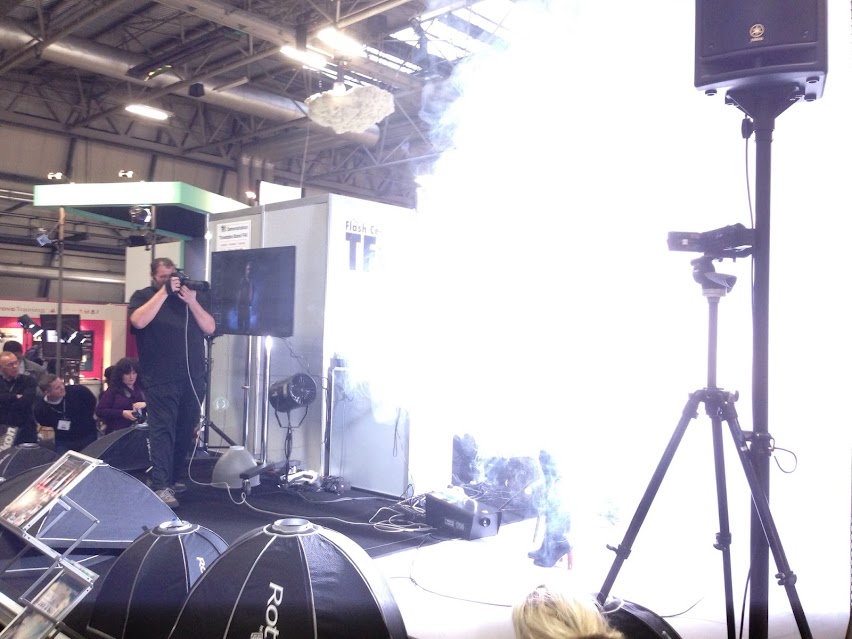
Made the annual pilgrimage to the NEC last Sunday.  Very quiet:  there was no queue on he M42, no queue to get into the car park either, and room to actually walk between the stands.  Quite a few big names missing.  Jacobs of course, who went to the wall last year.  Some new faces including Hasselblad and many familiar faces.  Was good to see Garry Edwardes on the Lencarta stand and their amazing new SF300 and SF600 high-speed IGBT based lights (basically big mains powered speedlights) with mind boggling 0.8 second recycle times at full power, and 1/20,000th of a second flash duration at minimum power on the SF300.  I’ll be buying one of those as soon as they come into stock in the next few weeks.

Frank Doorhof was on The Flash Centre stand demonstrating his approach to lighting and getting some amazing pictures with Maisy.  Here he is, having just blown Maisy away with the new point-and-destroy feature on the Sony Alpha 99…..

 Kabooooom!


It as great to talk to Frank after the show – I learnt the basics of how to light and meter from Frank’s videos on Kelby Training.

Did a bit of shopping:  bought a Lumiquest LTP softbox.  I like the Lumiquest design as it folds flat in seconds and fits in my camera bag.  I have also ordered a similar looking one from Hong Kong via eBay for £4.65 inc postage.  It’s rude not to at that price and I’m curious to see how they stack up as the Lumiquest one is £45.  Also bought a 1.2m Octobox from Bessel – with a difference.  I’ve already got a 1.2m Octa, however it takes a twenty minute wrestling match to put it up.  This new one, opens like an umbrella, and took me less than 2 minutes to construct, and 40 seconds to take down again, including attaching both diffusers and the grid.  Marvelous.  added to my clamp collection whilst at Bessel as well – can never have enough speedlight clamps, poles, and other light holding gear.

Images from the lighting workshop

Here are some of the things we went through in the workshop last month.  There was a lot of content to cover which meant restricting the amount of sets and lighting styles to cover each one in depth.  Our model for the day, Vicky provided all the outfits whilst hair and makeup was done by studio owner  Becky Hampson.   We started off with a simple beauty shot to talk about setting up 3 lights one at a time, starting with the key, using the light-meter to get the others at the exact ratio we wanted.  The background is provided by a 1.2 metre octabox, facing the camera and back-lighting the model.  Fill is provided by a strip box from below, and the key light is a diffused beauty dish.  This is a pretty formulaic and easily repeatable setup – it’s a bit like building your own Photo-Me! booth for beauty shots: once it’s set up and the lights are dialled in, you can just blast away.  There are lots of variations on this using reflectors instead of a second softbox for fill or with a Tri-Flector, or with a front-lit background and so on.  I like this set-up as the background light washes over the edges of the model – you just need to be careful not to crank up the background light too much or the light will eat into the edges of the hair and other fine detail.  You can meter this to get started, however this is really a creative decision – I tend to start at 2 stops over the key light, with the octabox about a foot behind the model. Continue reading

Nikon D800 – Devourer of storage…

I have now pressed the button on my D800E around 7500 times, and this is eating storage at an alarming rate.  Each NEF (raw) file with lossless compression (ie compression that does not lose any data as opposed to fractal compression algorithms like jpeg) weighs in at 40MB.  So every 25 shots is a Gigabyte.  The original 1TB drive inside my Dell XPS 8500 was fast filling up, and my old  500GB backup disk is now full.  I’ve also started using Photoshop more which means I save a .tiff file – at 600MB+ a time with layers intact, or 150MB flattened – more often than I used to. Continue reading

Shorter focal lengths cause distortion

(or longer focal lengths compress features)

This is a classic example of correlation being mistaken for cause and effect.   That is, 2 things being caused by a 3rd thing rather than one causing the other.  When we shoot portraits, you’ll often hear people saying “don’t shoot below 50mm or you’ll get distortion of the subject’s features”.  Or “shoot a longer lens to compress the background”.  It isn’t the focal length that is causing these effects, it’s the distance between you at camera and your subject.  The closer you get, the more distortion of features you get, as the nose (for example) is now proportionally a lot closer than the ears to your camera than if you shot further away.  The shorter focal length is also caused by you being closer – to get a wider view to fit the whole face in.

Try this – take the same shot at 200mm and 50mm with the camera and subject in the same position and then crop the wider shot so the subject is the same size – they will look the same.  In the same way the background is compressed when you move further away (ie the distance between subject and background is proportionally smaller to the distance between you and the background).  A longer focal length is caused by the increase in distance, to keep the subject filling the frame.

So, rather than focal length causing the distortion,  the focal length and the distortion are both caused by the close working distance.

Lighting Workshops in partnership with Body Couture Studios

Lighting workshop flyer

I am very excited to be  teaching a workshop on lighting at Body Couture Studios on the 26th January.  The workshop will cover some of the underlying science, a tour of the typical equipment used, and then move on to practical sessions covering how to meter the light, where to place the lights to get hard or soft light, how to adjust the position to balance the lighting on certain features of the subject, how to skim and feather the light and how various modifiers can be used to help achieve these goals.  These will be part demonstration and part hands-on for the attendees.

Finally, we’ll be looking at how to incorporate motion into your shots combining continuous and flash light for a classical dance shot.

The course is suitable for anyone who has never used flash before and wants a jump-start into the world of creative lighting, and people who are familiar with studio lighting and would like to take the next step in controlling the light to get the picture they have in their heads, onto the memory card.

The course is for a half-day on the morning of Saturday the 26th Jan (10am start) At Body Couture Studios in Congleton, Cheshire.  The cost is just £95 and you can book your place by calling Becky at Body Couture Studios on 0772 039 5723.  You can find out more about the studio at http://www.bodycouturestudios.co.uk


Landscape capture workflow


Some soap-box philosophy

Let me start by saying I don’t view my camera as a Polaroid instant camera.  That is, I don’t accept the efforts of the tiny processor and limited software inside it in producing a finished landscape image.   I see this sort of idea bandied about in print magazines and on forums across the intertubes:  “get it right in camera” they say.  What absolute rubbish.  What magic does it add to use the camera’s limited post-capture  processing as opposed to the might of Photoshop, Lightroom, Photomatix, Oloneo et al to produce the finished image?  It’s still processed by software.

“Don’t tamper with the image” is another axiom.  This is only important if you’re making a documentary.  Landscape photography is all about mood, emotion etc.  Who cares if the sky was really that colour?  Your camera doesn’t see what you see.  Your eyes cope with around 11 stops of light.  Your DSLR only around 5.   If you used a focal length much below or above 50mm, you are not capturing the field of view your eyes do, and the image will be distorted versus the one your eyes supplied to your brain.  Plus, if you shoot jpeg, your camera processed the image for colour, sharpening, contrast just the same as you might do in Photoshop – the only difference is that the settings were decided by the software engineers at Nikon/Canon et al a long time before you took the picture.  My point is – you already altered the scene by using a camera and not your eyes, and my advice (which can take or ignore of course) is that you get over this and liberate yourself from this restricted thinking.  Move forward to capture the mood of the scene – the emotion it evoked when you saw it.

I treat my camera as a data gathering device.  Nothing more.  I don’t use any of the post capture processing such as “Active D-Lighting”, “Magic pixie pixel improvement” or “picture control”.  I capture the raw data.  Even white balance and colour space are just tags in the image.  Specifying “ProPhoto” doesn’t capture any more data in the raw file.  Setting the white balance doesn’t affect what is captured – this tag just tells the viewing software how to render the colours in the picture.

OK I’ll now put away my handy fold-up soap box.

Continue reading

Five Point Palm Exploding Heart Technique


Dancer: Gabrielle Dams Crew: Suzy Clifford, Chris Steel, Lorraine Barnard, Clara Barnard. Time lapse BTS shoot: Clara Barnard Theatre technician: Paul Edwards Make-up: Gabrielle Dams Model Ageny: Becky Hampson, Body Couture Location: Grange Theatre, Hartford Special thanks to The Grange School.

Ever since I watched Joe McNally’s video about making a stroboscopic shot of ballet dancer Jen Concepcion, I wanted to shoot more dance.  Moreover I couldn’t get that shot out of my head.  I’ve learnt a lot of from Joe’s books and videos over the past year or so, and never travel without at least 1 speed-light these days (those rumours about me sleeping with an SB900 under the pillow are unfounded though).  Of all the shots I’ve watched Joe set up and make, this had to be the most complex in terms of technical lighting.  Not in terms of lighting finesse you understand – there are much more subtle arrangements of lights in Joe’s work.  But, shot in 3 parts, in camera with 3 commanders and for sheer speed-lightery, this was the Five Point Palm Exploding Heart Technique of lighting – and as time went by, I just had to try it to get it out of my head…. Continue reading

Photography Myths – “Full frame” = 35mm sensor

I always wondered – “who died and made 35mm the reference size?”  It’s popular for sure, but it seems a bit strange to call 35mm sensors “full frame” when there are plenty of bigger ones and even bigger slabs of film available.  So I did a bit of research.  “Full frame” does not mean 35mm film sized sensor.  In fact it has nothing to do with the size of the sensor.  “Full frame” refers to a type of CCD sensor that does not have “shift registers” interleaved between each photo-site to shift the values off the photo-diode.  The space this frees up can be occupied by more photo-diode (around 70% surface area is light sensitive in a typical full frame sensor) making them more sensitive to light. They are called “full frame” as they shift the full frame out of the sensor to the storage array at a time.  This also makes them subject to light smear as they are still collecting as the data clocks out line by line to the storage array.  Without interline shift registers, full frame sensors are cheap to make, but require a mechanical shutter to stop and start light collection.  Because of this they cannot do video, or live view.

Almost all digital cameras today are not full frame.   They have Interline Transfer CCDs that are equipped with shift registers interleaved between the lines of photo-diodes to transfer the data off the photo-diode and onto an accumulation register (which can then be clocked out to the storage array while the light sensitive area is collecting photons for the next frame – allowing electronic control of the image start and stop and doing away with the need for a mechanical shutter  (we then have to ask why manufacturers add mechanical shutters to their cameras – which cause all kinds of problems with vibration and for high speed flash – I don’t know why they do this and can’t find any explanation).  Because they have shift registers next to the photo-diode, only around 30% of the photo-site is light sensing material.  To compensate, these sensors have an array of “micro-lenses” on them to collect light from the full area of the photo-site and concentrate it down into that 30% area.

So, by this definition, if your camera, like mine, does video or live-view:  it ain’t “full frame” – no matter how big the sensor is.

Another meaning of “full frame” originates in the movie industry.  35mm movie cameras using the full size film gate were called “full frame” or “full gate”  https://en.wikipedia.org/wiki/Full_frame  Smaller gates could be used to save film (which would run through the smaller gate slower).

This is also meaningless to 35mm digital cameras unless (as on some Nikon 35mm cameras) you have the option shoot with less than the full frame.  Even then though, this makes no assumption about the actually size of the “full frame” – it could be anything.