Category Archives: Lighting

Flour

Now – there’s a joke in here somewhere about the model being self-raising, but to be honest, It’s too late in the day to be crafting that, so just make up your own and insert it here…

_OHL5221-EditHow much do you need?  I had no idea.  I’d seen a few flour (or “dust”) shots around on flickr, and Pinterest and this seemed like an ideal job for my new high-speed IGBT Lencarta studio lights – movement, flour backlit, hair flying etc.  Well, I bought 4 bags of Sainsbury’s most basic plain flour.  I now have 3 and a half bags of plain flour – which, as it turns out is not much use for baking anything…..

The venue of the flour experiment would be Millwood Photography in Stalybridge.  I highly recommend Millwood studio – Paul not only agreed to let me throw flour about in his studio, helped out on the shoot.  And the brave volunteer to be covered in flour?  Lizzie Bayliss.  I’ve shot with Lizzie before and she is one of the best models around.

Continue reading

Vodka

Product photography can get very involved.  Managing reflections, especially on shiny surfaces means you need to be very careful about that is in “sight” of the product surface.  Glass is double trouble, as every piece of glass has 2 surfaces – inside and out.  I’ve recently started to dabble in this and looked around for some ideas.  2 great places to go:-  photigy.com and Karl Taylor Photography.

_OHL4906-Edit


Continue reading

Dancing Again

_OHL4260I keep coming back to this dance theme.  There are a number of reasons.  Dancers, especially classically trained dancers hold themselves with a certain grace and poise.  (well “duh” I hear the rest of the world say, but well, yes it is obvious, however it is a reason why I’m attracted to dancers as subjects).  Next is the movement element – showing movement in a still photograph, whether it be a dancer frozen in mid-leap –where it’s obvious they are moving as they had to be to get up there, to showing multiple positions or a constant motion blur in the image to show the path they have taken.  I had shot with Gabby before, to produce a multiple flash image showing her path from stage right to stage left.  This time I wanted to explore motion freezing, and getting some blur on.

Gabrielle Dams, my subject for this shoot is only 18 years of age, and yet she dances, she sings and teaches a dance class of12-13 year old girls – who all adore her.  She’s very hard-working and always turns in a great performance.

Continue reading

Oh yes :) – and they work too.


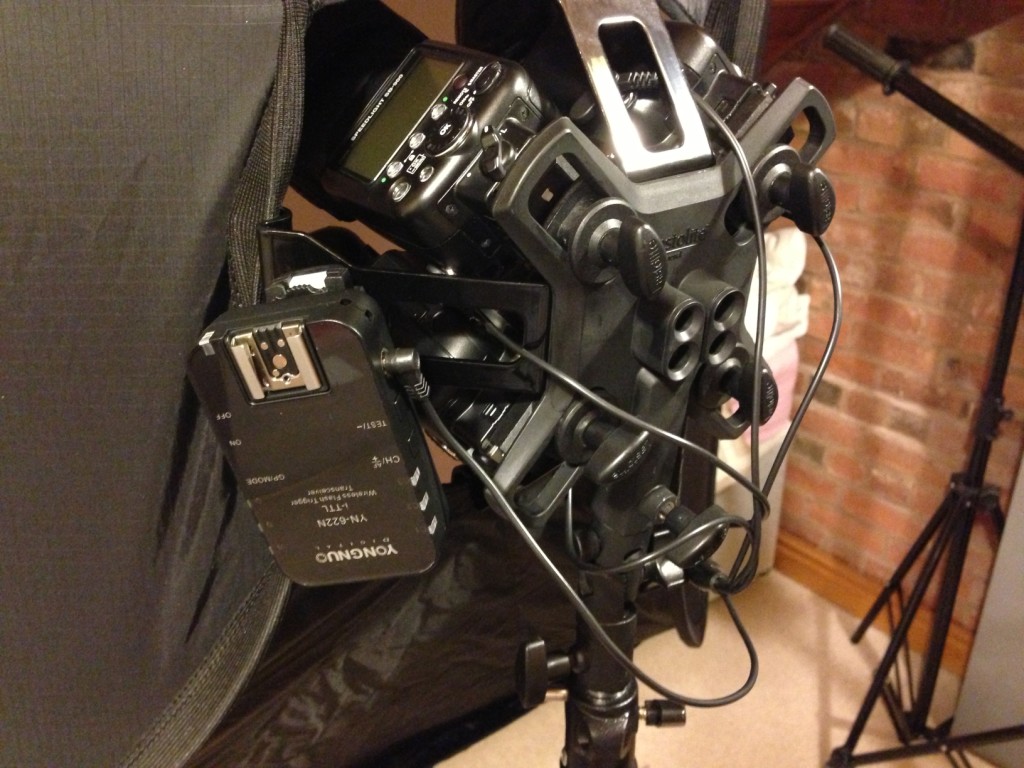
IMG_0764The Nikon CLS/AWS  (Creative Lighting System/Advanced Wireless System) flash system does many amazing things, with off-camera flash from strobing, full TTL metering with up to 3 groups of flash at independent power settings to just simple manual control of power output from camera.  However, it has one big weakness:  it send the data from the camera to the flashes with light pulses from either the on-board pop-up flash, or a Speedlight/SU800 infrared trigger attached to the camera hotshoe.  This means there must be a way for the light to get from the camera flash to the little sensor on the side of the Speedlight.  Some people call this “line of sight”.  It’s not quite that bad – you can bounce it off walls and ceilings etc as long as it reaches the sensor it will work.

But what if I put the flashes in a softbox?  Or outside/in another room?  If you’ve read Joe McNally’s “The Hot Shoe Diaries” you’ll know just how much of the setup on his shoots is spent getting the lights to trigger, with daisy-chained SC29 cords from the hotshoe to the master flash pointing out of a window and bouncing off a satellite…Well anyway, you get the idea – it’s frigging unreliable outside, and unworkable if the light is out of sight.

So, what if we could do the same over radio?  Pocket Wizard came up with the FlexTT5 and MiniTT1 system that does just that, however many reported it to be unreliable and there was no display on the trigger – the closest you could get was to buy a 3rd thing – the “AC3 Zone controller” that supplied the missing controls on the FlexTT5 to adjust up to 3 groups of flashes with thumbwheels.  Still no display mind you, and the whole thing cost a Gazillion pounds.  Radio poppers captured the light data and re-transmitted over the wire to a device that than re-emitted the light signals into the flash sensor.  Again, very expensive, but they did work perfectly.  Dave Black has used these to excellent effect over the years.  In later months Phottix launched the Odins which seemed to work well, but again, very very expensive at £150 per receiver.  Pixel had the Kings and again no display…

Continue reading

Grey is the new Green

_OHL0128-Edit-NCFXLight grey specifically.   People used to shoot on a Chroma key green or blue background to make cutting out easier (by selecting everything that is *that* green is was easy to cut out the model for pasting onto something else).  It is still popular in video work.  For stills though, you don’t need to bother with that, as the selection and matting tools in Photoshop these days are very good.  Using these green or blue background also reflects blue and green light onto your subject.  You do still need to blend in your model and create shadows, and match the lights and so on.

However!  Forget all that because if you shoot on a grey background you can just throw backgrounds on top and blend with overlay.  Mask off the model and you’re done. 

(Well ok there a few more steps but it’s certainly less tedious than the usual perfection-selection technique)

Continue reading

Flash!

Aaaahhhh.  Saviour of-my-photograph!_OHL5720

Ahem.  Sorry.  Won’t happen again.  Okay as promised this is the write up of the quick overview on flash I did recently for Holmes Chapel CC.  We talked about why we use flash guns – i.e. why do they flash, why are they not just on all the time so you can see what the light will look like?  There are couple of reasons, however the main one is the power of the light.  In daylight, even a 500watt work lamp would  struggle to make much impact.  We need a way to get a lot of light out in a very short space of time, so we can use a reasonable shutter speed (~1/160th) to control the ambient light.

Often, in a studio situation, we want to remove the ambient light altogether by stopping the lens down to a small aperture – say f/8 to f/16.  We then need a really powerful light to have it show up at all on the image – and deliver most of it within the window of time that the shutter is fully open.

Continue reading

Shutter speed effect on slow studio lights

The website for some very interesting new flashguns from MagneFlash mentions more than once that it outputs more light at faster shutter speeds than regular studio lights.  Now, conventional wisdom is that a run of the mill studio strobe takes about 1/900th of a second to output its light which is a lot quicker than the length of time the shutter is open below max sync speed (lets say this is 1/200th of s second which will work for most modern SLR cameras), and so as long as the shutter speed is longer than this, you should get all the light right?  I posted comment to this effect on LightingRumours.    This measurement is to “t.01” or the point at which the output is 1/10th of the peak output.  You need some sort of agreed point to make the measurement to compare lights. Continue reading

New workshop date for Feb – now *Sold Out*

New 5 hour workshop on lighting techniques with Body Couture Studios in Congleton.  Unlike the half and half lighting/photoshop workshop on the 19th Jan (which is now sold out), this is a pure lighting and shooting workshop.  Sunday 9th Feb from 11am to 4pm, I’ll be covering from simple, one light portraits up to incorporating movement.  From good light, to dramatic light, using gels, fog and fabric; softboxes, reflectors and grids.  Places are limited to 8 at £45 so call Becky at the studio quick if you want to reserve a place – the workshop on the 19th Jan is now sold out!  (see flyer below for details).  Visit http://bodycouturestudios.co.uk/  for location details.

PS and movement workshop poster-Edit

The Speed of Light

photo 2

Or, more importantly, the duration of the light really.  I’m gearing up to do some motion freezing shots using flash.  Now, why do this with flash?  We could just use a really high shutter speed and yes, the shutter on my Nikon D800E will go to 1/8000th of a second, which is fast enough to freeze most action in the “medium sized world”.  However, there are a couple of reasons why this is not a good idea.

First, for shots where we need to the camera to react to a noise, vibration or something breaking a detector beam, there may not be time for all of the mechanical gubbins inside the camera to lumber into action before the event is over:  the mirror has to raise, the whole shutter has to start it’s operation etc.  All of this can add as much as 50ms between the trigger event, and the exposure starting.  The second reason has to do with the amount of light we have to work with:  at 1/8000th of  second, not a lot of light is going to get in.

Now, one of the best things about speedlights is that you can’t alter the power.  Yep read that again 🙂  Speedlights do not work in the same way as conventional studio lights.  Whereas studio lights charge up their capacitors with just the right amount of energy for the light output you want, speedlights are always fully charged.  You control the amount of light by altering the duration of the light.  They have a tap inside – these days this is normally an Insulated Gate Bipolar Transistor or IGBT.  So rather than a trigger voltage discharging the whole cap across the flash-tube, your speedlight can turn the flow of electrical energy to the tube on and off.  The power of your speedlight btw, may amaze you.  Power is the rate or flow of energy (the rate of “doing work” in generic terms).  It is not the amount of energy delivered.  Your average speedlight holds around 80 joules of energy in its capacitors.  To empty them fully takes about 1/900th of a second.  1 watt is 1 joule per second, so dividing 80 by 1/900th gives us 72 kilowatts.  That’s a pretty bright light – for just over a millisecond…. Continue reading

Shooting models

_OHL0441-EditNo – not people from agencies – little models of cars.   Automotive shooters reckon you need a soft-box at least twice as big as the car to get great clean looking light on a car, which is basically a big convex shiny thing that reflects everything for miles around.  Who has a 20 ft soft-box?  hands-up?  Nobody?  Anyone get a car sized studio space with a diffusion panel under the roof?  No? Continue reading